Institutional Carbon Project 04 Profile
Carbon Project 02
Carbon Project 03
Carbon Project 04
OROKOLO BRM070 Institutional Carbon Project 04 Profile
Institutional Carbon Project 04 Profile
Project overview
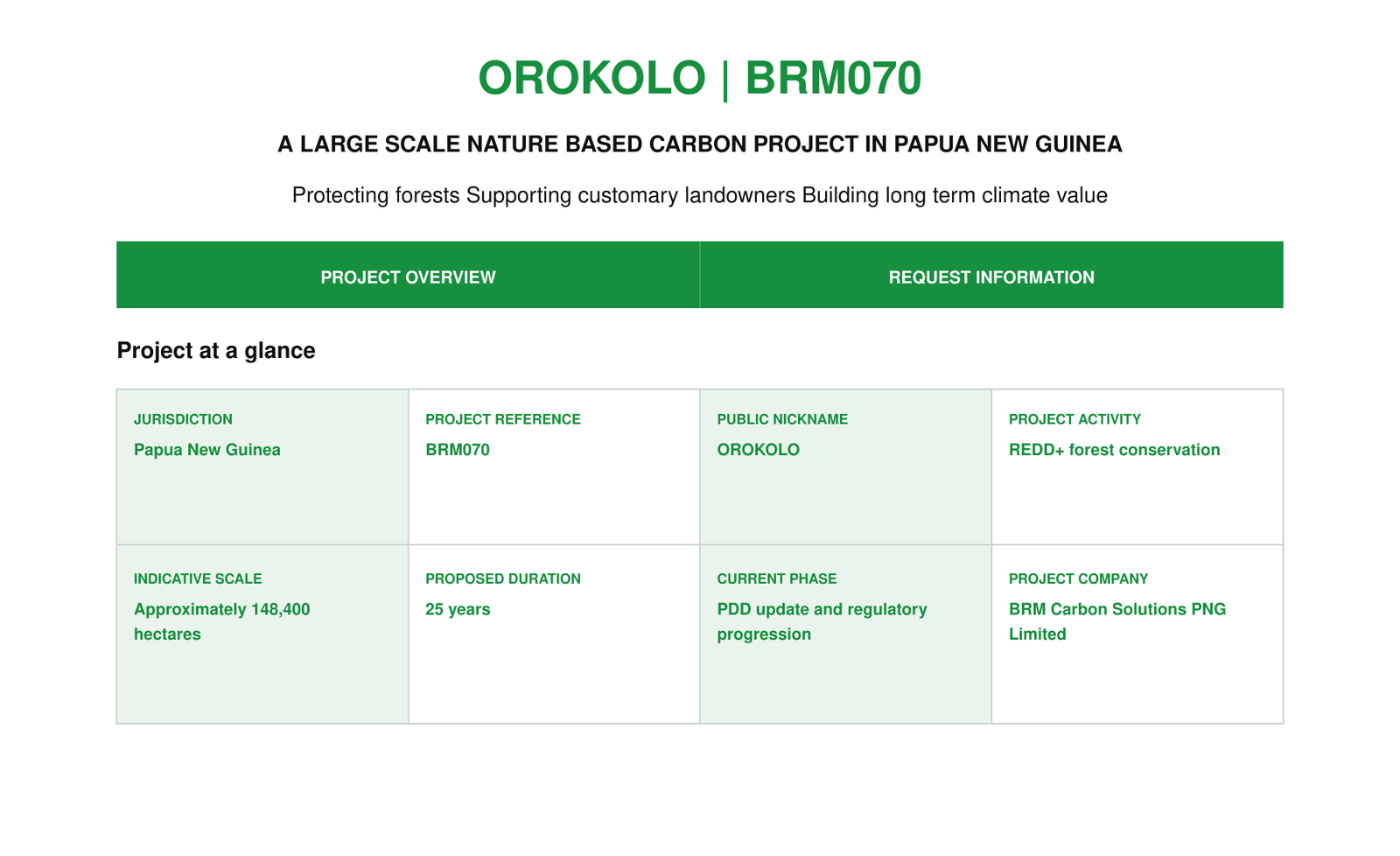
OROKOLO, reference BRM070, is a large-scale nature-based carbon project under development in Papua New Guinea. The draft Project Design Document describes an indicative project area of approximately 148,400 hectares spanning a connected landscape of coastal mangroves, waterways, lowland rainforest and lower-montane forest. The proposed activity is deforestation avoidance and REDD+ forest conservation over an indicative 25-year period.
The opportunity was originally developed through Hop2it and has been assigned to BRM Carbon Solutions for continuing development and commercialisation through its Papua New Guinea operations. A draft PDD was commenced to support the project transition and provides a substantial technical working foundation. BRM must nevertheless reconcile the inherited records, confirm the novation and authority to act, and update the project design against current sovereign, methodological and registry requirements.
Project Purpose and Opportunity
OROKOLO seeks to protect a large forest landscape previously exposed to commercial logging and continuing land-use pressure. The draft PDD records that most of the area remains naturally forested, while some historically disturbed areas are regenerating. The project concept is to conserve standing forest, reduce further degradation and support recovery while preserving customary access, community livelihoods and the ecological functions of the landscape.
The commercial objective is to progress a credible REDD+ project through updated technical documentation, government requirements, an eligible methodology, independent assessment and an appropriate registry pathway. Any future Carbon Credit Units will depend on confirmation of the eligible boundary, baseline, additionality, leakage and permanence controls, safeguards, monitoring arrangements, validation, verification, sovereign approval and issuance. Draft forecasts are not issued or guaranteed credits.
Forest Landscape and Environmental Value
The source describes a distinctive landscape transitioning from coastal mangroves and wetlands through dense lowland rainforest to upland and lower-montane forest. Rivers and streams connect the project environment and support access, customary activities and watershed functions. This ecological range provides a strong basis for integrated forest protection, but detailed location, waterway and boundary information should remain confidential.
The draft PDD characterises the wider region as predominantly humid tropical forest with high canopy cover and important native biodiversity. It identifies intact and regenerating forest, natural habitats and potential watershed value. Historical geospatial statistics and biodiversity metrics must be refreshed and independently reviewed before quantitative claims are published. Sensitive species records and detailed ecological mapping belong in controlled technical files.
Customary Landowners and Community Participation
Customary landowners and affected communities are central stakeholders in OROKOLO. The project framework is intended to recognise customary rights, local knowledge and community decision-making through continuing engagement and documented authority. BRM must verify land and stakeholder records and confirm that inherited agreements, consultation and consent remain complete, current and appropriate following assignment and novation.
The draft safeguards framework includes Free, Prior and Informed Consent, social mapping and landowner identification, inclusive consultation, gender participation, a grievance redress mechanism and transparent benefit-sharing governance. Subject to approved plans and available project revenue, potential benefits may include local employment, training, forest-monitoring roles and agreed investment in health, education, welfare and community infrastructure. Specific benefits should not be promised before approval.
Technical Development Approach
Technical development includes updated satellite and geospatial analysis, land-cover classification, historical forest-loss review, deforestation-driver assessment, field verification, carbon-stock assessment and safeguards documentation. The draft PDD refers to change detection, terrain modelling and vegetation analysis. BRM should establish a traceable evidence chain linking the legal project boundary, project rights, stakeholder records, remote-sensing outputs and field data.
The revised PDD must resolve differing draft area references and define the eligible boundary, baseline scenario, additionality, leakage risk, permanence measures, carbon pools, monitoring methodology and benefit-sharing arrangements. Methodology references, calculations, forecasts and maps must be tested against current data and the requirements of the selected carbon standard, registry and Papua New Guinea authorities. Historical estimates should not be presented as independently assured results.
Monitoring Permanence and Risk Management
The proposed monitoring system combines satellite observation, periodic change detection, field reporting and locally informed surveillance. It is intended to identify logging, fire, agricultural expansion and other disturbances, with each observation connected to dated evidence, investigation and management response. Carbon, biodiversity and social monitoring should use defined indicators and retain records suitable for independent assessment.
Permanence, leakage and reversal-risk arrangements will be finalised under the selected methodology. Potential measures include risk analysis, buffer or reserve requirements, community protection activities, sustainable funding and response procedures for severe weather or unlawful forest disturbance. Monitoring should also examine whether project activity displaces pressure beyond the boundary and whether community safeguards remain effective.
Current Development Priorities
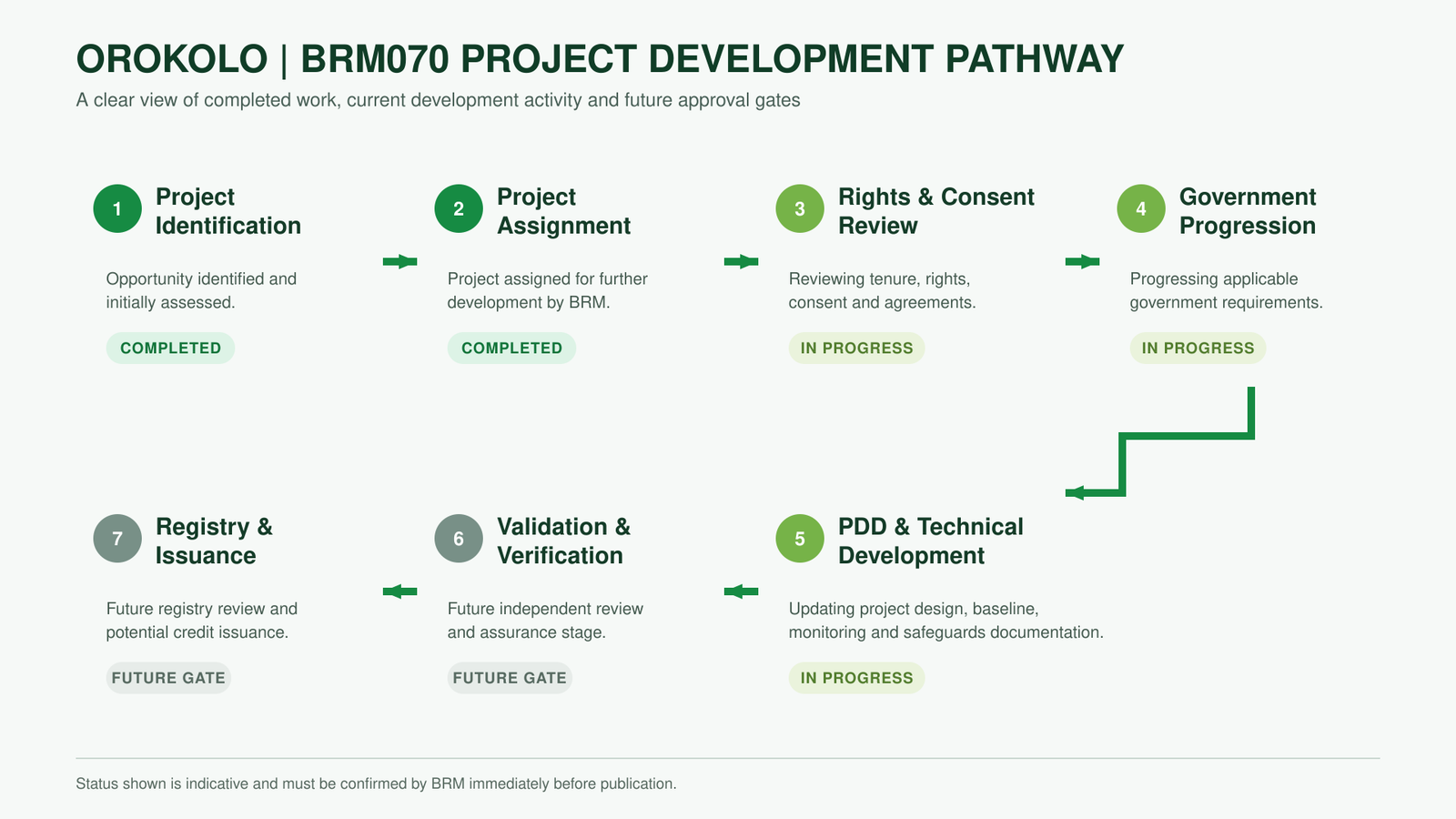
The immediate priorities are to complete the novation and assignment record, reconcile the inherited project file, confirm BRM authority to act, and verify customary tenure, stakeholder authority, consent and government engagement. The legal boundary must be reconciled with the technical area, and the draft PDD should be reviewed for internal inconsistencies, outdated corporate references and claims requiring contemporary evidence.
The active technical workstream is to update the PDD and safeguards package, refresh mapping and baseline evidence, select the current methodology and registry pathway, and continue landowner and government engagement. Independent validation and verification, registry submission, issuance and commercial sale remain later-stage outcomes and must not be represented as completed while these approval gates remain outstanding.
Governance and Integrity
BRM Carbon Solutions PNG Limited is identified as the project company for this public profile, subject to confirmation before publication. Governance is intended to combine BRM commercial oversight, Papua New Guinea operational management, customary-landowner participation, government engagement and independent technical assurance. Novation, assignment, project agreements, authority to act and development rights should be retained in the controlled project record.
BRM will progress OROKOLO in accordance with applicable Papua New Guinea requirements and the rules of the selected carbon standard or registry. Public communications should distinguish clearly between a draft PDD, development milestones, indicative forecasts and credits that have been independently verified and issued. Historical or draft statements should not be repeated as current approvals without documentary confirmation.
Commercial Engagement
BRM may engage with qualified strategic buyers, project investors, technical partners and prospective carbon purchasers during development. This public profile is an institutional overview and does not replace due diligence. Detailed information should be released only through an approved process that protects customary-landowner information, project rights and BRM commercial interests. Access may require identity checks, evidence of capacity, confidentiality undertakings and acceptance of deal-room conditions.

Project Status Notice
ORIOLI remains a project under development. It is subject to confirmation of the project assignment, continuing project rights and stakeholder consents, technical updates, applicable Papua New Guinea government requirements, selection and acceptance of an eligible methodology, independent validation and verification, registry requirements and final issuance. Project area, timing, crediting period and estimated carbon outcomes may change as due diligence and technical work progress. No statement on this page constitutes a representation that carbon credits have been issued or are guaranteed to be issued.